Tuesday, April 5, 2011

New Homes in 2015 Will Be Smaller, With a Touch of Green

By: Stephani L. Miller


Architects and builders think new homes will continue to shrink under the driving forces of demographic shifts and other influences.

According to a recently released survey by the NAHB, residential architects and designers, home builders, and others involved in the new home construction sector believe that the home shrinkage phenomenon of the recession years won't be reversing as the economy regains steam, but is actually here to stay. The sentiment among the majority of respondents to the NAHB's "The New Home in 2015" survey is that the average new home will continue to shrink by as much as an additional 10 percent—to about 2,152 square feet—by mid-decade.

Smaller footprints and greener features ranked at the top of the trend list among survey respondents, with 74 percent saying homes will get smaller and 68 percent saying homes will get greener in 2015—far surpassing the other trends the survey evaluated: more technology (29 percent), greater accessibility (20 percent), and more outdoor living features (10 percent).

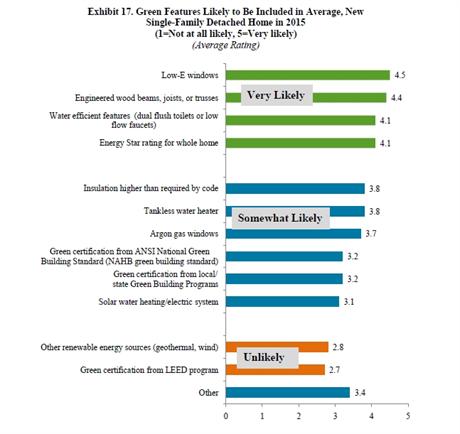
It's interesting to note, however, that the green features cited as most likely to be included in new homes in 2015 are largely the most cost-effective methods for achieving energy and resource efficiency. Survey respondents indicated that low-E windows, engineered wood components (joists, beams, and trusses), water-efficient fixtures, and Energy Star Home ratings are likely features.

"According to our experts, consumers are really looking to reduce their energy costs. When they say 'green' that's what they mean: reducing the cost of heating, cooling, and running their house," says Rose Quint, assistant vice president for survey research, NAHB Economics and Housing Policy. Because other, potentially higher-performing energy-saving features cost more up front and have longer payback periods, and because mortgage financing is still so tight, many of the other features that would increase the green quotient of a new home fall further down on consumer wish lists, according to respondents.

It's not just economics and energy costs driving the size reduction in new homes, the survey found. Consumer expectations and preferences also are shifting. Homes no longer hold the equity they once did, and homeowners no longer view their residence as an investment that will fund their retirement or help them upgrade to a larger home, according to Quint. Also a driving force toward smaller houses is the population of aging baby boomers seeking to downsize.

As earlier housing trend reports have indicated, the NAHB survey found that single-purpose or special-function rooms (media and hobby rooms, mudrooms, dining rooms) are far less likely to be included in the new homes of 2015. The great room is again on the rise, combining a house's main living and entertaining space, workspace, and cooking/eating space. It was ranked the most likely room to be included in the average new home in 2015. The only area deemed likely to grow in the next five years, according to the survey, is the family room. Fifty-two percent of survey respondents said the living room will merge with other spaces, while 30 percent said it will vanish altogether.

"People have become more realistic about their needs, and they're going to base their purchases on needs rather than wants and lifestyle preferences," Quint says. "A house becomes less expensive when you take away walls and combine multiple living spaces into one room. It also allows for a sense of greater volume within a shrunken footprint."

Interestingly, while more universal design features were deemed only somewhat likely to be included, survey respondents' comments indicated that accessibility will be planned for in more subtle ways than creating a house that's fully accessible at time of sale. Rather, the infrastructure to ease future accessibility retrofits and renovations will be provided in new homes of 2015—which incidentally will play an increasingly important role in the remodeling industry.


Read more findings from "The New Home in 2015" report on HousingEconomics.com.

Friday, March 4, 2011

Green Depot Acquires Ecohaus


Deal adds three West Coast stores to NYC-based green building materials dealer.
By: Craig L. Webb

Green Depot, which dubs itself the nation's biggest building material dealer specializing in environmentally sustainable building products, grew even larger Monday when the New York-based company announced it has acquired Ecohaus, a similar operation with locations in Seattle, San Francisco, and Portland, Ore.

The deal creates "the first one-stop supplier for green building materials with a nationwide footprint for distribution and delivery," Green Depot said in a news release. The move comes 15 months after Green Depot established a Chicago beachhead with the acquisition of Greenmaker Supply. (Related story)

Green Depot currently has 10 showrooms in the New York boroughs of Manhattan and Brooklyn; Boston; Manchester, N.H.; Albany, N.Y.; Long Island, N.Y.; Newark, N.J.; Philadelphia; Newark, Del.; and Chicago. It also serves customers through its website and claims 33 warehouse distribution centers as a result of its relationship with the Marjam supply house. (Related story)

Established in 1992, Ecohaus "has been a pivotal player in the industry, introducing eco-friendly products to consumers and working with innovators in the field to bring high-quality, sustainable products to market," the announcement stated.

"Our core values and passion align completely," said Green Depot founder Sarah Beatty. "By joining forces with Ecohaus, Green Depot is strongly positioned for continued growth throughout America. We’re delighted to combine resources and work together to achieve our shared vision for a diverse, sophisticated Green supply chain--and a sustainably thriving America."

Ecohaus CEO David Silverglide said the deal builds on the West Coast's well-known appreciation for green products and "opens up promising new avenues to feed the demand for affordable, healthy, and sustainable product solutions across the country."

While the earlier deal with Greenmaker Supply called for that company to keep its name, the Chicago store eventually was renamed Green Depot. In contrast, Ecohaus' website already points to Green Depot's and it appears clear that the West Coast stores will take the Green Depot name.

Friday, January 28, 2011

Buyer Survey Says: Smaller Homes With More Open Spaces

Consumer preferences are examined in the latest studies conducted by the NAHB and Better Homes & Gardens.
By: John Caulfield

The trend among buyers favoring smaller homes with open and multifunctional rooms continued in 2010. But subtle changes in tastes, combined with ongoing shifts in household occupancy, could give alert builders and their product suppliers new opportunities over the next few years, as the housing market recovers and home buyers get back in the game in larger numbers.

Fresh surveys of consumer preferences, presented during a seminar on that topic at the International Builders' Show in Orlando, Fla., on Thursday morning, provided an in-depth look at what consumers are shopping for now and what they might be looking for in the future. While there were no eureka moments in the survey’s findings, they reaffirmed demographic factors that are influencing what is getting built these days and made clearer what features home buyers are seeking.

At the very least, consumers are approaching the home buying experience with a different attitude. “The sense of entitlement that people used to feel about having everything they wanted in their homes is being replaced by a sense of gratitude for things they already have,” says Jill Waage, editorial director of Better Homes & Gardens' Home Content Core.

Rose Quint, NAHB’s assistant vice president for survey research, laid the groundwork for this seminar by sharing projections about household formation and new-home construction. Projections of population growth—which is expected to rise to 322.4 million people in 2015, 336.8 million in 2020, and 422.6 million in 2050—suggest that demand for housing should remain vital. Over that time span, America’s Hispanic population will increase to 30% of the total, from 16% today; and people over 55 years old will account for 31% of the total, from 25%.

Houeseholds are getting smaller, too. One- and two-person households represented more than 63% of all households in 2010. And for the first time, married couples accounted for less than 50% of households, while unrelated adults living together increased to 6.2%.

In light of these statistics, the average size of a home completed declined last year to 2,377 square feet, from 2,438 square feet the previous year and 2,570 square feet in 2007. But Quint pointed out that the average size of a home started last year actually inched up a bit to nearly 2,400 square feet, although most of the bigger homes were started in the South and Midwest. “So this is by no means an phenomenon,” she said.

Quint shared new research in which the NAHB asked builders what they would be building in 2011. More than half, 52%, will build smaller homes, and nearly three fifths will build houses with less expensive price tags. Looking ahead to 2015, three quarters of the builders polled thought that single-family homes would continue to shrink (to around 2,152 square feet, on average); 68% thought they would be more energy efficient; but only 29% expect houses of the future to include more technology.

These builders expect that more one-story homes will be built, and more than half expect houses to combine living rooms with other rooms, with family rooms getting larger. (Thirty percent thought living rooms, per se, could vanish altogether). Among the features builders think more homes will include in the coming years are great rooms, low-E windows, double kitchen sinks, and programmable thermostats; indeed, a sizable percentage of builders expect more homes to be Energy Star rated.

However, 61% of builders polled expect the number of features offered as standard to decrease (compared to 32% who were asked the same question in 2007).

Waage followed Quint with a presentation that focused more specifically on the kinds of rooms and features buyers prefer, based on a survey, conducted last December, of 2,000 of her magazine’s readers who identified themselves as either planning to buy or remodel a home.

The survey found that buyers may have downsized as much as they’re going to, as 40% said their next home would be larger than what they live in today. Buyers are still looking for an affordable and energy efficient home with lots of storage space, but those criteria are slightly less important than they were for survey respondents in 2009.

Waage showed data that indicates buyers are taking a lot longer researching purchases and projects than they did only a few years ago. They are also prioritizing features, with efficient HVAC systems and appliances topping the list, followed by decks and patios, low-maintenance exteriors, and private backyards. They’re doing the same prioritizing for living spaces, with separate laundry, office, and storage rooms being most coveted.

However, don’t expect home buyers to overextend themselves: Better Homes’ survey found that 58.4% of readers polled are “extremely reluctant” to spend money they don’t have.

John Caulfield is senior editor for BUILDER magazine.

2011 Builders' Show Preview

12 green products from the residential construction industry’s largest event

The International Builders’ Show returns to Orlando, Fla., next week. As always, hundreds of manufacturers will be on hand showcasing new wares for the residential contractor, including an array of options for sustainably minded builders. Here’s a look at 12 green products that will be on display.

Click here for slideshow.

Wednesday, December 29, 2010

Baby Boomers, Gen Y, and the Recession Shift Long-Held Housing Tastes and Trends

The economy and jobs are reshaping the household picture, a ULI panel says, as Gen Yers delay buying and boomers age in place. Among all groups, walkability and transit dominate the wish list.
By:Katy Tomasulo

As the housing industry continues to claw its way out of the downturn, the recession and unemployment picture are dramatically influencing the way consumers view homeownership, according to the “Housing in America” panel during ULI’s fall conference in Washington, D.C. As the country’s two largest demographic groups—baby boomers and Generation Y—reassess priorities, household formation is down; tastes and demands are shifting toward walkable, transit-oriented communities; and the overall buyer profile within age groups is simply not as cut-and-dried as it once was.

Even as housing recovers, we’re not going to return to the same trends and tastes, says John McIlwain, senior resident fellow at ULI. “What people will want … will be substantially different.”

Among all age groups, the economy continues to be the chief driver. The jobs outlook is not only impacting sales and inventory, but also household formation, which has dropped to 25% of the norm, McIlwain reports, stemming from a decrease in immigration and the recession forcing young adults to live with their parents (or even vice versa). This trend, he says, won’t reverse until unemployment begins to drop.
Though the recession hit everyone hard, its impact on Gen Y will likely have the most long-lasting influence on housing trends. With 83 to 85 million people born from 1981 to 1999, it’s the largest demographic group the country has ever had, and therefore has massive buying potential. Problem is, they’re also the most economically constrained, McIlwain says, with a 30% unemployment rate and an average $23,000 post-college debt. They’re not saving for a down payment, and their parents, struggling to recover their own retirement savings, can’t help.

As a result, this age group’s view of the American Dream of homeownership is vastly different. “People in the youngest generation have seen the struggles family and friends are going through, and the assumption of the house as a wealth generator is very different,” says Marty Jones, president of Corcoran Jennison Cos.

Richard Koss, director of economics at Fannie Mae, found similar changes in consumer surveys conducted during the past year. In January, 70% of consumers surveyed viewed homeownership as a safe investment; by July, that percentage had dropped to 67%; in 2003, confidence was as high as 83%.

The combination of these factors, McIlwain says, will likely lead to unprecedented rental rates during the next 10 years.

GEN Y OPTIONS
To meet the challenge, developers and builders must find a way to provide products that Gen Yers can afford in locations they desire. Among their wants and needs:

Urban settings or, if suburban, walkable town centers and mixed-use communities. They desire smart growth and density, and are willing to accept a less ideal home if they can walk to work and retail.

A focus on work-life balance and connectivity.

WINKs: Woman with income, no kids. This group, typically 26 to 29 years old, is highly educated. They’re renters, but are likely to buy before marriage. Like others, they desire walkable neighborhoods near transit.

More young adults are delaying marriage; 85% of household growth will be households without kids, says Charles Hewlett, managing director of real estate advisor Robert Charles Lesser & Co.

BABY BOOMER TRENDS
Baby Boomers begin turning 65 next year. Here is how this group will continue to impact housing trends:

They’re retiring earlier than previous generations; however, many still work, either part-time, in a lower-level position, or as a consultant.

Many will age in place; however, in 10 years, we will see increased demand for seniors housing as the first wave reaches the mid and late 70s.

The earlier prediction that baby boomers will move to downtown urban areas has not happened, Hewlett says. But they are looking for what he calls “safe urbanism”—walkable, denser areas with transit.

They want locations with an affordable cost of living and quality healthcare. Both of these factors trump climate, Hewlett notes.

They look for communities with opportunities for continuing education, culture, and an active lifestyle.

They still count Florida and Arizona among the top five retirement locations, but the Carolinas, with slightly cooler temperatures and lower threat of hurricanes, are becoming their new Florida, Hewlett says.

ADDITIONAL INFLUENCERS
Among the challenges and trends across markets:

Golf course communities are out; conservation communities with passive open space and trails are in.

Walkable, transit-oriented communities or those with town squares are “going to be a key part of creating projects that attract interest,” says Jones.

Immigration will continue to be a huge housing influencer; however, where previous generations settled in urban areas, many new immigrants are heading straight for suburbs, says Hewlett.

In the rental market, green is still being driven more by investors than consumers, Jones reports.

The U.S. will grow by another 100 million people by 2040, and 60% of that will come from just 20 metro areas, primarily in the coastal areas and the south.

Finally, there’s the question of what will happen to the McMansion. In new construction, too-large houses have fallen out of favor—but what about existing homes? The vast gap in numbers from baby boom to Generation X, along with continued economic woes and shifting tastes, left one panelist to wonder who will buy baby boomers’ larger houses and what further impact those properties will have on buying trends over the next few years. Stay tuned.

Katy Tomasulo is Deputy Editor for EcoHome.

Wednesday, December 15, 2010

Favorite Home Shows of 2010


Those of you needing a shot of home decorating inspiration this year needed to look no further than your TV remotes. From home renovations to painting advice and cheap fixes, there were plenty of shows to inspire. The Nate Berkus Show debuted in September, and the preview of Secrets of a Stylist has everyone excited for its premiere in 2011! HGTV is the go-to channel for the majority of home decor shows, but there are several other shows that are not to be missed, including Planet Green's The Fabulous Beekman Boys.

Sunday, December 5, 2010

Focus on Fire Safety: Holiday Fire Safety


Decorating homes and businesses is a long-standing tradition around the holiday season. Unfortunately, these same decorations may increase your chances of fire. Based on data from the National Fire Protection Association (NFPA) and the U.S. Fire Administration (USFA), an estimated 250 home fires involving Christmas trees and another 170 home fires involving holiday lights and other decorative lighting occur each year. Together, these fires resulted in 21 deaths and 43 injuries.

Following a few simple fire safety tips can keep electric lights, candles, and the ever popular Christmas tree from creating a tragedy. Learn how to prevent a fire and what to do in case a fire starts in your home. Make sure all exits are accessible and not blocked by decorations or trees. Help ensure that you have a fire safe holiday season.

Christmas Trees
What’s a traditional Christmas morning scene without a beautifully decorated tree? If your household includes a natural tree in its festivities, take to heart the sales person’s suggestion – “Keep the tree watered.”

Christmas trees account for hundreds of fires annually. Typically, shorts in electrical lights or open flames from candles, lighters or matches start tree fires. Well-watered trees are not a problem. A dry and neglected tree can be.

Caring for Your Tree
Do not place your tree close to a heat source, including a fireplace or heat vent. The heat will dry out the tree, causing it to be more easily ignited by heat, flame or sparks. Be careful not to drop or flick cigarette ashes near a tree. Do not put your live tree up too early or leave it up for longer than two weeks. Keep the tree stand filled with water at all times.

Disposing of Your Tree
Never put tree branches or needles in a fireplace or wood-burning stove. When the tree becomes dry, discard it promptly. The best way to dispose of your tree is by taking it to a recycling center or having it hauled away by a community pick-up service.

Holiday Lights
Maintain Your Holiday Lights
Inspect holiday lights each year for frayed wires, bare spots, gaps in the insulation, broken or cracked sockets, and excessive kinking or wear before putting them up. Use only lighting listed by an approved testing laboratory.

Do Not Overload Electrical Outlets
Do not link more than three light strands, unless the directions indicate it is safe. Connect strings of lights to an extension cord before plugging the cord into the outlet. Make sure to periodically check the wires – they should not be warm to the touch.

Do not leave holiday lights on unattended!

Holiday Decorations
Use Only Nonflammable Decorations
All decorations should be nonflammable or flame-retardant and placed away from heat vents. If you are using a metallic or artificial tree, make sure it is flame retardant.

Don't Block Exits
Ensure that trees and other holiday decorations do not block an exit way. In the event of a fire, time is of the essence. A blocked entry/exit way puts you and your family at risk.

Never Put Wrapping Paper in the Fireplace
Wrapping paper in the fireplace can result in a very large fire, throwing off dangerous sparks and embers that may result in a chimney fire.

Candle Care
Avoid Using Lit Candles
If you do use lit candles, make sure they are in stable holders and place them where they cannot be easily knocked down. Never leave the house with candles burning.

Never Put Lit Candles on a Tree
Do not go near a Christmas tree with an open flame – candles, lighters or matches.

As in every season, have working smoke alarms installed on every level of your home, test them monthly and keep them clean and equipped with fresh batteries at all times. Know when and how to call for help. And remember to practice your home escape plan!

After the holidays, don’t throw your natural tree away! Here are some tips on what to do with your tree after the holidays. In general, you have these options:

Curbside pick-up for recycling - Most areas will collect trees during their regular pickup schedules on the 2 weeks following Christmas. There are often requirements for size, removing ornaments, flocking, etc; see below for details.
Call for an appointment to have a non-profit in your area pickup your tree. Some boy scout troops are offering a pickup service for a small donation (often $5).
Take your tree to a drop off recycling center. Most counties have free drop-off locations throughout the county. Usually, you may take up to two trees to any of the following drop-off locations at no charge.
Cut the tree to fit loosely into your yard waste container.